

15.05.2026
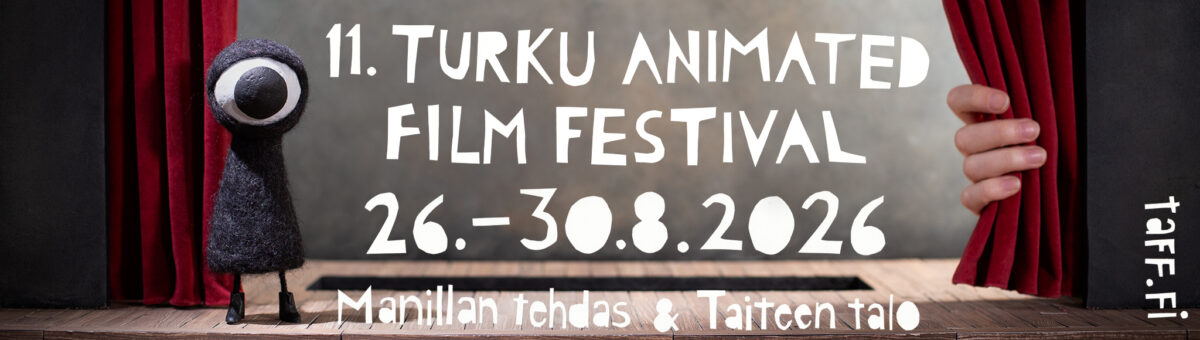
The official look for TAFF 2026
The new visual identity and trailer for the 11th TAFF is here!
The playful new look and the stop-motion trailer are the work of Turku-based animation artist Anni Oja. TAFF interviewed Anni about this year’s cheerful look and trailer.
Anni Oja (b. 1986) is an animation artist from Turku whose superpowers lie in her incredibly skillfully crafted puppets and their masterful animation. She holds a Master of Arts degree from the University of Lapland and a degree in animation directing from Turku University of Applied Sciences. In her work, Oja utilizes a variety of techniques, ranging from digitally drawn images to handmade crafts and object animation: her work often features concrete objects, the delicate texture of materials, and the play of light and shadow, all brought to life through the camera. She also works as a graphic designer, set designer, and animation instructor at the Turku Arts Academy.
Anni is a coveted puppet animator: she has worked as an animator on projects such as the Lithuanian film Hoofs on Skates (2024) (prod. Kadrų Skyrius, dir. Ignas Meilūnas). Her award-winning animated film The Moustache (2015) was a festival favorite and won several awards, including the Risto Jarva Award at the Tampere Film Festival in 2016.
Watch the festival trailer below:
“Animation isn’t just movement; it’s movement with meaning. Through different rhythms and timings, we create the illusion of life. A character might be nothing more than a soup ladle, but with the right animation rhythm, it comes to life.”
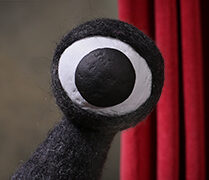
Anni, this year’s design features the Taffeli character as a fluffy puppet. Can you tell us more about how the design came about?
In keeping with this year’s theme, stop-motion and puppet animation were the obvious choice of technique. After a bit of back-and-forth, a traditional theater stage seemed like the perfect setting. Felted wool, on the other hand, is a handy surface material: it leaves no seams, and the end result is easily fun and fluffy. Big-eyed, lovable Taffeli steered the visual style in a more playful, perhaps even childlike direction. I added gold stars to the curtains and even ended up using glitter, even though I usually shy away from it a bit.
You specialize in stop-motion animation. In your opinion, what can puppets or puppet animation convey that might not be possible with other methods?
Puppet animation and stop motion are, in their own way, limited forms of animation: physical objects that are animated in the physical world can’t just do whatever they want, compared to, say, traditional animation, where a character can float in the air or change shape. For me, these limitations serve as inspiration: I have to come up with tricks and workarounds to get the job done. The more traditional and handmade the method of achieving the desired result, the better. Often, though, I’ve gotten myself into trouble with this, and things have gotten pretty tight in the studio.


“What matters most to me is working with my hands and appreciating that. Hands are incredibly important to an animator. If you lose the use of your hands, you can’t draw, type on a computer, or bring a puppet to life.”
We find ourselves on a puppet theater stage with red curtains. The stage is, after all, one of the most primitive venues for storytelling. How does three-dimensional animation create a sense of space for the viewer in a different way than, say, two-dimensional animated film?
You could say, easily, since the space constructed in front of the camera is inherently three-dimensional. But building a space and capturing it on film involves much more than that: I find it inspiring how lighting, camera angles, optics, the arrangement of subjects, and so on can be used to emphasize a sense of space. Of course, the same applies to other techniques as well, but in stop motion, the construction of the image is a concrete, physical playground. Should I move this prop a little forward, dim that light a bit, shift the camera slightly to the right… I can easily spend days tinkering with these details.
The trailer is quite literally a product of your own handiwork, as it centers on your own hands. How important are traditional craft skills to your artistic practice?
Traditional skills and techniques are certainly close to my heart, but I’m not averse to new methods either. What matters most to me is the act of creating with my hands and appreciating it. Hands are incredibly important to an animator. If you lose the use of your hands, you can’t draw, type on a computer, or bring a puppet to life. That’s why I want to celebrate the hands of every artist in this trailer— hands that have created a host of wonderful films for us to see at this year’s TAFF.
The theme of this year’s festival is “Animated to Life.” What does that mean to you personally?
”Animated to Life” captures the essence of animated movement, regardless of the technique used. Animation is not merely movement; it is movement with meaning. Through different rhythms and timings, the illusion of life is created. A character could be as simple as a soup ladle, but with the right animation rhythm, it comes to life.
What is your relationship with TAFF?
TAFF is a wonderful place to meet people, enjoy movies, and soak up the great atmosphere. I don’t think I’ve ever missed a single year.
Send your greetings to the TAFF audience!
Everyone, come on over! See you in August!
Turku Animated Film Festival (TAFF) 2026: The “Animated to Life” theme brings together creators from the worlds of animation and puppetry. TAFF is an international festival focused on animation, held in Turku. Finland’s largest event dedicated to the art of animation will be held for the 11th time from August 26–30, 2026, at the Manilla Culture Factory and the Art House Turku.